Architecture Papers and Downloads Architecture Books List Architect Skills Bibliography (articles and papers) Architect Training, Consulting and Mentoring Overview topics: Role of the Architect Columns - Architect: What's in a name? - Architect's Charter: Complexity Architecture Training
What it Takes to be a Great Architect Class - Chicago, IL, April 24-26, 2007
- Palo Alto,
CA,
March 13-16, 2007 Enterprise Architecture Workshop
- Palo Alto,
CA
March 5-8, 2007
|
Design Yourself,
then Design Your Own Curriculum!
We are again looking at curriculum design for architect development,
and would sincerely value your input.
First, we would like to invite you to envision what you would like to
accomplish, and then think about what would help you get there.
“The indispensable first step
to getting the things you want out of life: decide what you want.”
-- Ben Stein Your personal vision: Where do you want
to be in 2 to 5 years? What role would you like to be in, with what
responsibilities and rewards? What would you like to have
accomplished, in that time? How would you like to be viewed, by your
peers, managers, and others you work and associate with? To reach these goals,
what would you need to know, be able to do, and what
personal characteristics would you need to build (on)?
Your
personal circle of excellence:
Draw a circle.
Think of a situation where you were really “on,” where you were at
your best. What personal characteristics made you shine in that
situation? Write these in your circle.
Repeat, with another
situation.
Your benchmark: Think of stellar
architects, leaders, strategists, innovators, politicians,
technologists you have worked with, and think of what capabilities
and qualities made them effective.
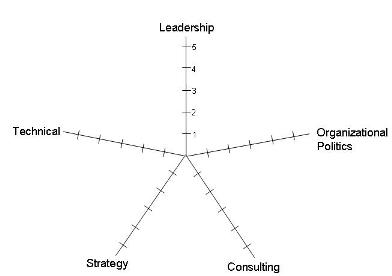
You might find it helpful to use the chart at
right, to think about where you are, and where you would like to be.
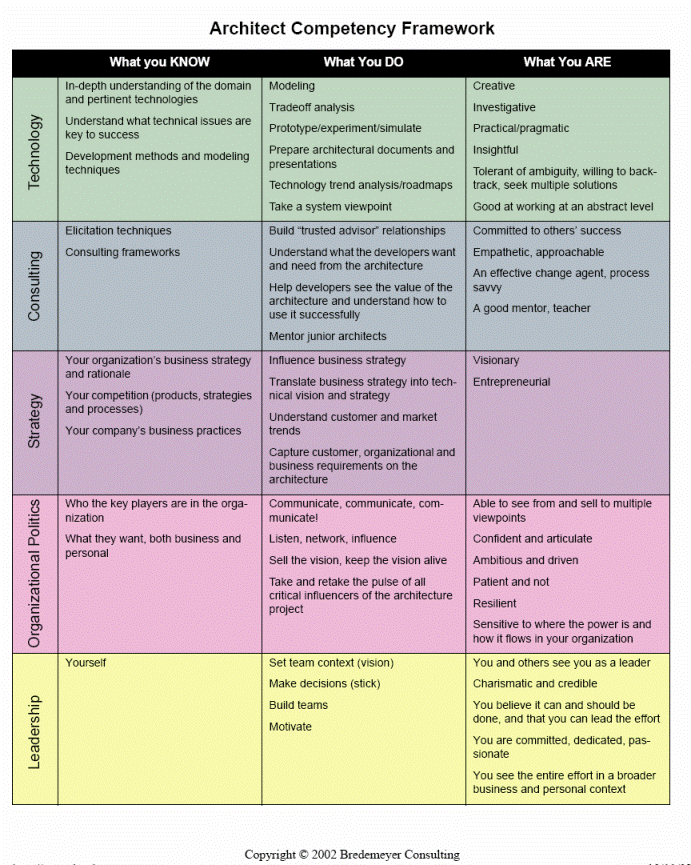
The axes refer to the architect competency bands in the
Architect Competency Framework below. Formulate your own personal development plan.
Please share it with us (email:
ruth at bredemeyer.com); we will maintain your
confidentiality and only use your input to improve our offerings. It will
enable us to better serve you.
Please ask other architects in your network of
influence to do this. It will be valuable to them to reflect on
their aspirations and path to achieving their career objectives, and
we would value their input. So,
please point them to this page:
Design Your Own Curriculum
(or
http://www.ruthmalan.com/Journal/JournalCurrent.htm#Design_Your_Own_Curriculum).
We would strongly prefer to hear what you believe will help you
develop along your architect career path, rather than get your
reactions to what we have proposed, though the latter is of value
too.
Understanding the "foundation" layer
(in the table below) assumes
you are aware of
our
Visual Architecting (VAP) workshops, and in particular that you
understand that these were designed to weave a “full-encounter”
experience that mimics the multi-dimensional nature of architecting
in the real world, helping to stimulate a focus shift as well as
providing useful techniques that help the architect along the path
to good, right and successful architecture.
For the other
development layers, we will figure out which pieces get
delivered in which formats (reading, online training, workshops,
community of practice formats like share/learn/do/reflect/debrief,
team interventions, etc.) at a later point, once the topics have
been firmed up.
Technical Lead,
Product Line, Domain or
Portfolio Architect
Chief Architect
Ground
Project experience
UML, RUP
Design patterns
Architect experience
VAP
Foundation
Architecture concepts and practices (VAP
workshop, 4 days)
Architect role and competencies (3 days)
Architecting across products: concepts
and practices for product line and portfolio architects (4
days)
Case studies in excellence: leaders,
strategists, innovators, and politicians
Good: technically sound
Technical specialist topics/
-
services
-
security
-
integration
-
resource management
-
scalability and availability
-
decomposition and (re)factoring
-
distribution and remoting
- system health monitoring
- business intelligence
Conceptualization and visual modelling
Architecture case studies
System thinking and system modelling
Patterns and practices addressing
multi-product/cross-system concerns:
-
integration
-
consistency and integrity
-
leverage
Product line (platform/family) case
studies
Technical strategy
Technology
briefings
Architecting business capabilities
Right: meets stakeholder goals and concerns
System concept formulation and
architectural requirements
Creativity and innovation
Technical Risk Management
Trade-off analysis
Design reviews
System envisioning and innovation
Product and portfolio strategy
Roadmaps, radars and dashboards
Architecture assessments
Business strategy
Strategy and innovation briefings
Successful: delivering strategic value
Giving and receiving feedback
Technical communication
Architect case studies
Group facilitation
Leading teams
Technical consulting
Persuasion and influence, communication
and effectiveness
Dealing with politics, parochialism and
anarchy (negotiation and conflict management)
Leadership:
Leadership briefings
Consulting with business leaders
Organizational politics This curriculum leverages our Architecture
Competency Framework and Competency Elaborations, by Ruth Malan
and Dana Bredemeyer:
Architect Competency Framework (6 kb). 1 page summary of the
architect's domains of competency (what you know, what
you do, and what you are).
Leadership Competency Elaboration (21 kb). This module
elaborates on the leadership competency domain in our Architect
Competency Framework.
Strategy Competency Elaboration (19 kb). This module
elaborates on the strategy competency domain in our Architect
Competency Framework. You may be interested in our
Strategy Primer for Architects.
Organizational Politics Competency Elaboration (25 kb). This
module elaborates on the politics (or organizational
effectiveness) competency domain in our Architect Competency
Framework.
Technology Competency Elaboration (26 kb). This module
elaborates on the technology competency domain in our Architect
Competency Framework. To get a head-start with self-study, you may
want to look at
various resources related to these architect competencies.
And, of course, you could read back through the archives of Ruth
Malan's
architects architecting architecture journal.
|
Copyright ©
1999-2007 by Bredemeyer Consulting
URL: http://www.bredemeyer.com
Page Created: April 26, 2006
Last Modified:
April 11, 2008